
One roofer says they can start tomorrow. The leak is fresh, the number looks lower than the others, and for a minute that feels like good news. Then the question that actually matters cuts through the urgency: if the job needs a permit, if a worker gets hurt, or if hidden damage shows up after tear-off, who is taking responsibility on your property?
That is where we think Los Angeles homeowners should slow down. The safest choice is not the contractor with the fastest promise or the cheapest line item. It is the contractor who can prove the job will be legal, insured, supervised, and documented before any deposit changes hands.
If you want help reviewing your roof project with licensing, insurance, permit responsibility, and on-site oversight clearly explained, SOL Roofing can walk you through the process before any deposit is paid.
When people search for the best roofer in LA, what they usually want is lower risk. They want to know the work will be done by a properly licensed roofing contractor, that permit responsibility is clear, that inspections will not become their problem later, and that someone competent will actually be in charge once the roof is opened up. That is the standard we believe matters most.
In California, roofing is not a vague trade category. It has a specific license classification, and for most residential roofing work, homeowners should expect a contractor operating under the proper C-39 roofing classification. That matters because a nice website, a wrapped truck, or a confident salesperson does not tell you whether the company is legally set up to perform the work being sold.
We encourage homeowners to treat public verification as the starting point, not the final step. If a contractor says they are licensed, the next move is simple: verify it. In a market as busy as Los Angeles, where older homes, additions, slope changes, and detail-heavy reroof projects are common, the difference between a sales claim and a documented license record can become very expensive very quickly.
Just as important, qualification is bigger than the license number itself. A genuinely prepared contractor should be comfortable showing how the project will be managed, who supervises the crew, how changes are documented, and what happens if city inspectors require corrections. We think that level of clarity is part of being qualified, not a bonus.
How to check the license record before you sign
The California Contractors State License Board gives homeowners a public way to check whether a roofing contractor is active and properly classified. That record is far more useful than many people realize. Before signing anything, we recommend confirming that the license is active, that the business name matches what is on the proposal, and that the classification fits roofing work rather than some unrelated trade.
You should also pay attention to whether the record raises questions about workers’ compensation status or other issues that deserve explanation. If the paperwork in front of you says one thing and the public record suggests another, stop there and get clarity first. Good contractors do not get irritated when homeowners verify facts. In our view, they should expect it.
Another practical point: make sure the entity you are hiring is the same entity shown in the record. Homeowners sometimes receive proposals under one company name, then see permit discussions, payment instructions, or crew references tied to something slightly different. That kind of mismatch is exactly the sort of small detail that can turn into a larger accountability problem later.
Insurance answers should be specific, not reassuring
Once the license checks out, the next question is insurance. This is where vague language causes trouble. “We’re covered” is not proof. A homeowner should be able to request current insurance documentation and understand, in plain terms, what coverage is in place and who carries it.
Workers’ compensation is especially important. If people are performing physical roofing work on your home, you do not want uncertainty about who covers an on-the-job injury. Roofing is high-risk work by nature, and Los Angeles homeowners should be very cautious about any contractor who gets slippery on this subject, answers indirectly, or suggests it is not something you need to worry about.
General liability matters too, but the broader point is accountability. We believe a responsible roofer should be ready to explain what proof they can provide, whether crews are employees or subcontracted in some capacity, and how that structure affects supervision and coverage. If the answer gets confusing fast, the risk usually does not disappear. It just shifts toward the homeowner.
Permits are a hiring issue, not a paperwork footnote
In Los Angeles, permit handling should be discussed before work begins, not after materials arrive. Depending on project scope and jurisdiction, permit requirements can vary, so no trustworthy contractor should make blanket claims without seeing the job. What matters most is that responsibility is clearly assigned in writing: who determines whether a permit is required, who pulls it if needed, who schedules inspections, and who handles corrections if the city flags something.
That clarity protects the homeowner in several ways. First, it reduces the chance of work moving ahead on assumptions that later trigger delays or stop-work problems. Second, it prevents the all-too-common handoff where the contractor blames the city, the city points to missing paperwork, and the homeowner is left trying to sort out a process they never agreed to manage.
We think a strong proposal should make permit responsibility feel boringly clear. If a contractor says permits are “usually not necessary” without explaining why, or acts as if inspections are someone else’s problem, that is not efficiency. That is exposure.
What accountability looks like once the crew arrives
Many hiring mistakes do not become visible until install day. The proposal may look fine, but then the homeowner realizes they do not know who the foreman is, who is authorized to discuss hidden damage, or whether anyone on site is clearly directing the work. For us, this is one of the biggest differences between a contractor selling a roof and a contractor managing a job.
On a properly run project, there should be a clear chain of responsibility. Someone should be identifiable as the on-site supervisor or foreman. Homeowners should know who communicates schedule changes, who documents conditions uncovered during tear-off, and who can explain next steps before extra work proceeds. Older Los Angeles homes often reveal surprises once the roof is opened, so this part is not hypothetical. It is operational reality.
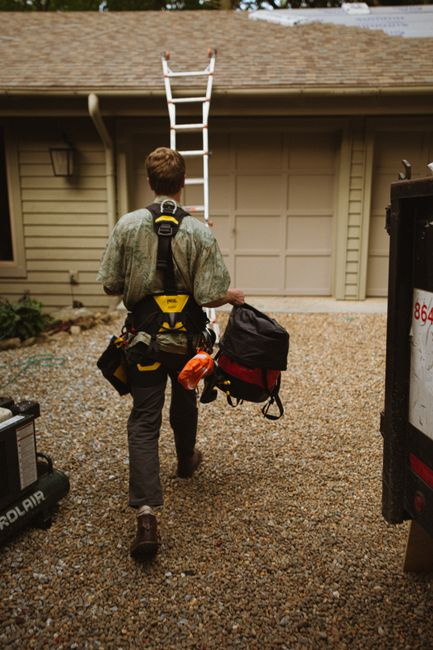
Safety belongs in that same conversation. Recent roofing enforcement in Los Angeles County has made fall protection, ladder practices, first-aid readiness, and heat-illness planning more than abstract talking points. If a home is steep, tall, or complicated, the homeowner should feel comfortable asking how safety is handled on site and who is responsible for enforcing it. A serious contractor should not treat that as an annoying question.
We also think documentation standards matter here. If hidden damage appears, there should be a process for photos, explanation, pricing, and written approval before scope changes move forward. That protects both sides. It keeps the homeowner informed, and it keeps the contractor accountable for what was found and why the recommendation changed.
The proof to collect before paying a deposit
If you have estimates in hand, this is the compact pre-deposit checklist we believe is worth using.
- Active California license verification with the proper roofing classification and matching business identity
- Current proof of insurance, including clear workers’ compensation status
- Written explanation of who handles permits, inspections, and any required corrections
- Name or role of the on-site supervisor or foreman who will oversee the crew
- Written process for documenting hidden damage and approving change orders
- Clear communication expectations for schedule updates, inspection timing, and jobsite questions
If a contractor can produce those items cleanly, the conversation changes. You are no longer relying on tone, urgency, or price alone. You are evaluating whether the company is prepared to run a controlled job on your property.
Pressure tactics and other warning signs
Watch for urgency being used to bypass verification. Emergency situations are real, and sometimes temporary protective work has to happen fast. But “we can start tomorrow” is not the same as “we can responsibly manage your project.” If speed is the main selling point, ask whether the license, insurance, permit plan, and supervision details are ready right now as well.
Be cautious with “no permit needed” claims. Permit triggers depend on scope and jurisdiction, so a contractor should explain the basis for that statement rather than toss it out casually. In Los Angeles-area work, we think homeowners should be especially careful when a company seems eager to make permit questions disappear.
Do not let subcontractor responsibility stay fuzzy. If part of the work will be performed by others, ask who supervises them, whose insurance applies, and who owns corrections if something goes wrong. Ambiguity here often becomes finger-pointing later.
Be wary of owner-builder suggestions you did not ask for. In some situations, homeowners are encouraged to pull permits themselves to simplify things for the contractor. That may transfer responsibility in ways many homeowners do not fully understand. If that idea comes up, slow the conversation down and ask why the contractor does not want to carry that responsibility directly.
Short answers to the edge cases homeowners ask about
Is a permit always required for roofing work?
Not every situation is identical, and requirements can depend on scope and local jurisdiction. That is exactly why we do not think homeowners should accept blanket yes-or-no answers without an explanation tied to the actual project.
What if I need help immediately because of active damage?
Temporary protection and emergency response may need to happen quickly, but verification still matters for the larger repair or replacement decision. Fast service should not erase the need for license, insurance, and responsibility clarity.
What if the paperwork and verbal answers do not match?
Trust the mismatch as a signal to pause. If a proposal, public record, or insurance proof conflicts with what you were told, ask for correction before you sign or pay anything. A well-run contractor should be able to resolve that clearly.
Should I pull the permit myself if the contractor suggests it?
We would be cautious. Homeowners should understand exactly why that is being suggested and what responsibility they may be assuming. In many cases, the cleaner path is working with a contractor prepared to handle permit accountability directly.
This is the framework we believe homeowners should use when comparing roofing proposals in Los Angeles. If a contractor can verify licensing, explain insurance clearly, define permit responsibility, identify on-site supervision, and document changes properly, you are dealing with a much safer starting point. That is the standard we work to meet at SOL Roofing, and it is the level of proof we think you should expect before any deposit is paid.
From license verification and insurance clarity to permit handling and crew supervision, SOL Roofing works to provide the documentation and communication homeowners should expect before moving forward.


